
Kelly on One Bet Is Not Kelly on a Slate
A bet sizing calculator answers one bet at a time. A Saturday card is not one bet at a time. Here is what happens to the first five positions when a sixth arrives, and why the reason is your bankroll rather than the games being related.
A bet sizing calculator asks you three things. What are the odds, what is your estimated probability, how big is your bankroll. It gives you back a number. That number is correct, and for one bet it is the whole answer.
Then Saturday arrives and you have eleven games you like.
Run the calculator eleven times and you get eleven correct numbers. Add them up. On a lot of cards that sum lands somewhere north of half your bankroll, all of it live at the same time, none of it settled. If you meant to cap how much of the bankroll is live at once, that card is already a problem. So something has to give, and the interesting question is what.
What the single-bet formula can and cannot see
The familiar Kelly formula solves one bet at a time. It asks what fraction of the bankroll should go into this opportunity, without knowing that five other positions are about to make claims on the same bankroll.
That distinction disappears when bets settle one after another. The first bet settles, the bankroll changes, and the next bet is sized against the new number. Each calculation sees a bankroll that is actually available.
A Saturday card is different. Six bets can go in before any of them settle. Run the single-bet calculation six times and each calculation sees the entire bankroll. None of them knows the other five exist.
That is the entire mechanism. It is not subtle, and it is not about the games.
What it looks like with numbers
Take a $10,000 bankroll, quarter Kelly throughout, everything priced at -110, and a total exposure cap of 10%. That cap is a normal thing to want: it says no more than a tenth of the bankroll is at risk before anything settles.
Five positions, sized independently:
| Bet | Your estimate | Quarter Kelly | Stake |
|---|---|---|---|
| A | 58% | 2.95% | $295 |
| B | 57% | 2.42% | $242 |
| C | 56% | 1.90% | $190 |
| D | 55% | 1.38% | $138 |
| E | 54.5% | 1.11% | $111 |
| 9.76% | $976 |
That fits. Just barely, but it fits, and every stake is exactly what the single-bet calculation says it should be.
Now a sixth game appears and you make it 56%, same as C. On its own it is worth 1.90%, or $190. The card is now at 11.66% and the cap is breached.
So the sixth bet does not get added on top. It takes its share, and the other five hand some back:
| Bet | Was | Now | Change |
|---|---|---|---|
| A | $295 | $253 | −$42 |
| B | $242 | $208 | −$34 |
| C | $190 | $163 | −$27 |
| D | $138 | $118 | −$20 |
| E | $111 | $95 | −$16 |
| F | none | $163 | new |
| $976 | $1,000 | at the cap |
Nothing about bets A through E changed. Same games, same prices, same estimates. The only new information in the world is that you found a sixth game you like, and it cost your strongest position $42.
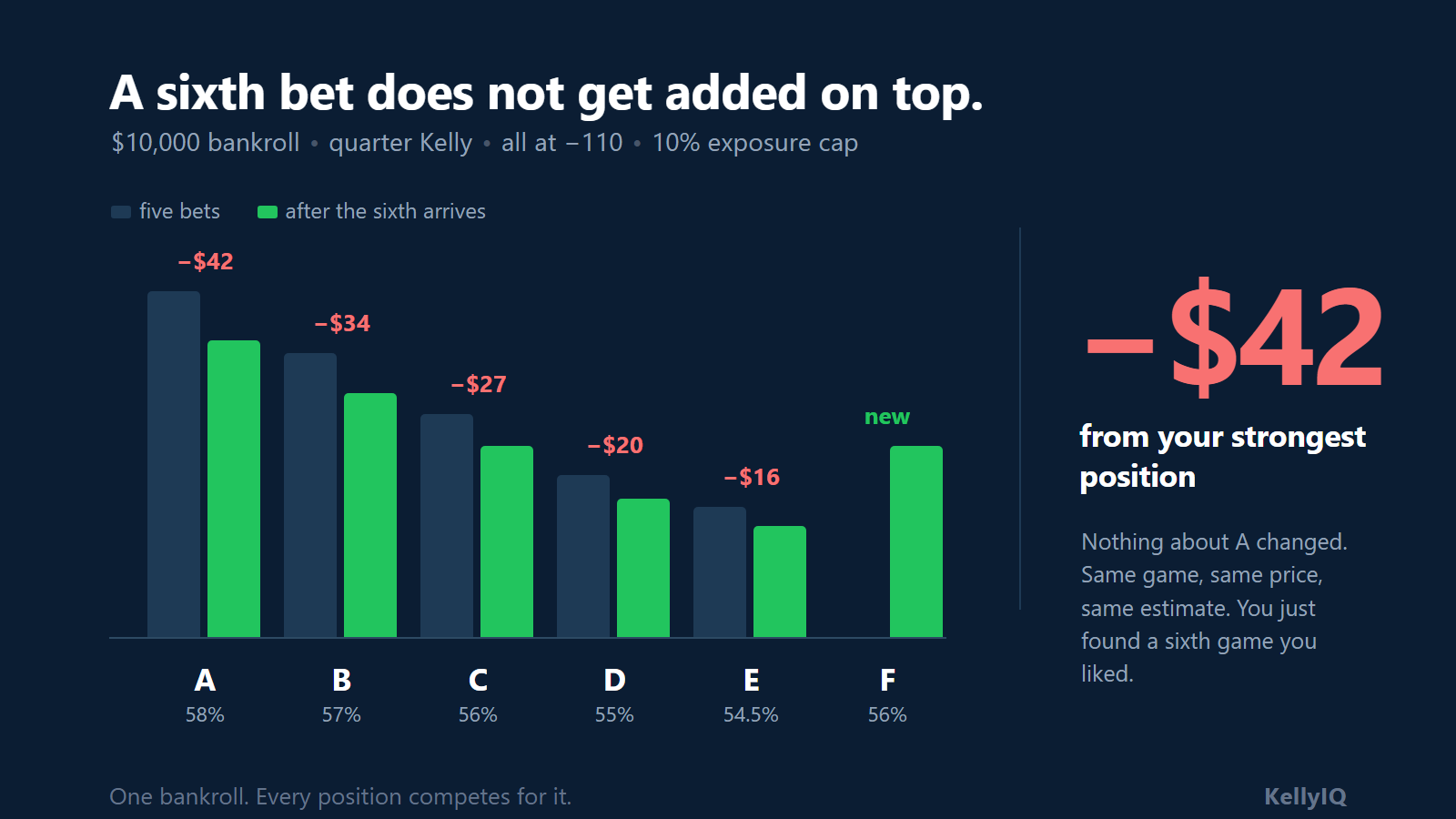
(That table scales every position by the same factor, which is the simplest way to respect a cap and the easiest to follow. A growth-maximizing allocation under the same constraint generally will not be exactly proportional, because it will protect the positions carrying more edge per dollar committed.)
It is the bankroll, not the games
The obvious guess is that this has something to do with the games being related. Three overs on the same hot afternoon, two sides of the same division race, that sort of thing.
It does not. Every bet in that table could be in a different sport on a different continent and the arithmetic would be identical. KellyIQ models bets as independent. The positions compete because they are funded from one finite pot and they are all live at once, and that is true of six unrelated games exactly as much as six related ones.
This matters because it changes what you do about it. If the problem were relatedness, the fix would be picking less similar games. It is not, so the fix is deciding how one budget gets divided.
The constraints that only exist at the card level
Once you are allocating rather than calculating, a set of questions appears that a single bet cannot raise:
- Total exposure. How much of the bankroll is allowed to be live before anything settles.
- Per-bet ceiling and floor. No single position dominating the card, and nothing so small it is not worth the ticket.
- How many positions. If the budget only supports six, and you like eleven, which six.
- The shape of the downside. Not just the average outcome but what the bad afternoons look like.
None of these can be answered one bet at a time, because none of them is a property of a bet. They are properties of the card.
What to actually do with this
If you are sizing by hand, the practical version is short. Decide your total exposure first, before you look at any individual game. Then treat that number as the thing being divided rather than a limit you check afterward. It changes the order of the questions: not how much is this bet worth but what share of today does this bet deserve.
And accept the part that feels wrong. Finding a sixth good game is genuinely good news, and it still makes your best position smaller. Those two facts sit together and neither one cancels the other.
The bankroll does not grow because you found more things to bet on.
KellyIQ models bet allocation under your own probability estimates and your own constraints. It does not predict games and it does not tell you what to bet. Sports betting involves risk of loss. 21+, US only.
Frequently asked questions
KellyIQ is a modeling tool. It produces allocation outputs under user-defined assumptions and does not recommend, advise, or predict any wagering outcome. For entertainment; 21+, US only. If gambling is a problem, call 1-800-GAMBLER.
Get new posts by email
Occasional writeups on sizing, risk, and portfolio construction. No picks, no hype.
By submitting, you agree to our Privacy Policy. Unsubscribe at any time.