
Why Flat Betting Is Costing You Money
You can win your bets and still lose money. The gap is almost always bet sizing. Here's why flat betting quietly bleeds a winning bettor, and what to do instead.
You can be a winning handicapper and a losing bettor at the same time. If that sentence annoys you, this post is for you, because the gap between the two is almost always the least glamorous part of betting: how much you put on each bet.
Everyone obsesses over what to bet. Almost nobody talks about how much. Yet sizing is the variable that decides whether a real edge compounds into growth or gets handed back to the book. Here's why the most common approach, flat betting, quietly costs you, and what the math says to do instead.
What flat betting is (and why it's the default)
Flat betting means risking the same amount on every wager: $100 a game, every game, win or lose. It's the first real discipline most bettors adopt, and that's to its credit. It stops you from chasing losses or dumping your bankroll on a "lock." Compared to sizing on emotion, flat betting is a big step up.
But it's a default, not a strategy. And it has one flaw that costs you in both directions.
The flaw: it treats every bet as equally good
Some of your bets are strong reads. Some are near coin-flips you talked yourself into. Flat betting puts the exact same money on both.
That's wrong two ways at once:
- On your best bets (the ones where you genuinely have an edge) you're underbetting, leaving growth on the table.
- On your marginal bets (the near coin-flips) you're overbetting, taking on risk that isn't paying you enough to hold it.
Your money should follow your confidence. Flat betting can't, because it only knows one number.
The fix: size by your edge (the Kelly Criterion)
Bet sizing is actually a solved math problem. It's called the Kelly Criterion, and it's been used by professional gamblers and investors for over sixty years. In plain English, it says:
Bet a fraction of your bankroll proportional to your edge. Bigger edge means a bigger bet. Smaller edge means a smaller bet. No edge means no bet.
The one honest input it needs is your true win probability, as a number. "I like this team" can't be sized. "I think they win 57%" can.
A quick worked example, which you can reproduce in the Kelly calculator. Say you have a $1,000 bankroll and two bets at -110 (risk $110 to win $100):
- A strong read you rate a genuine 60% winner. Full Kelly there is about 16% of your bankroll, around $160.
- A more modest read at 54.5%. That's still a real edge, since -110 breaks even at 52.4%, but full Kelly is only about 4.5%, around $45.
If you're flat-betting $100 on both, you're putting the same money on a bet that carries ~$160 and one that carries ~$45. You're underbetting the strong one by better than a third and overbetting the modest one by more than 2x. Multiply that across a whole slate, every week, and the leak is enormous.
You'll want to bet less than Kelly says, on purpose
Full Kelly assumes your probability estimate is exactly right. It never is. Overestimate your edge and full Kelly overbets aggressively, which is how bankrolls get wrecked.
That's why most disciplined bettors use a fraction: half Kelly or quarter Kelly. You give up a little long-run growth in exchange for a lot less variance and a far lower chance of a deep drawdown. Fractional Kelly is the sweet spot between "growing" and "surviving."
The part nobody tells you: a winning record can still go broke
Here's where it gets uncomfortable. Sizing isn't just about growing faster. It's about not blowing up. To show it, we ran a simulation: the same picks, a real 55% win rate, 100 bets, one season, played out 50,000 times. Two bettors, identical results, differing only in how they sized:
- Bettor A risks a disciplined 2% of bankroll per bet.
- Bettor B risks 25% per bet, "because he's sure."
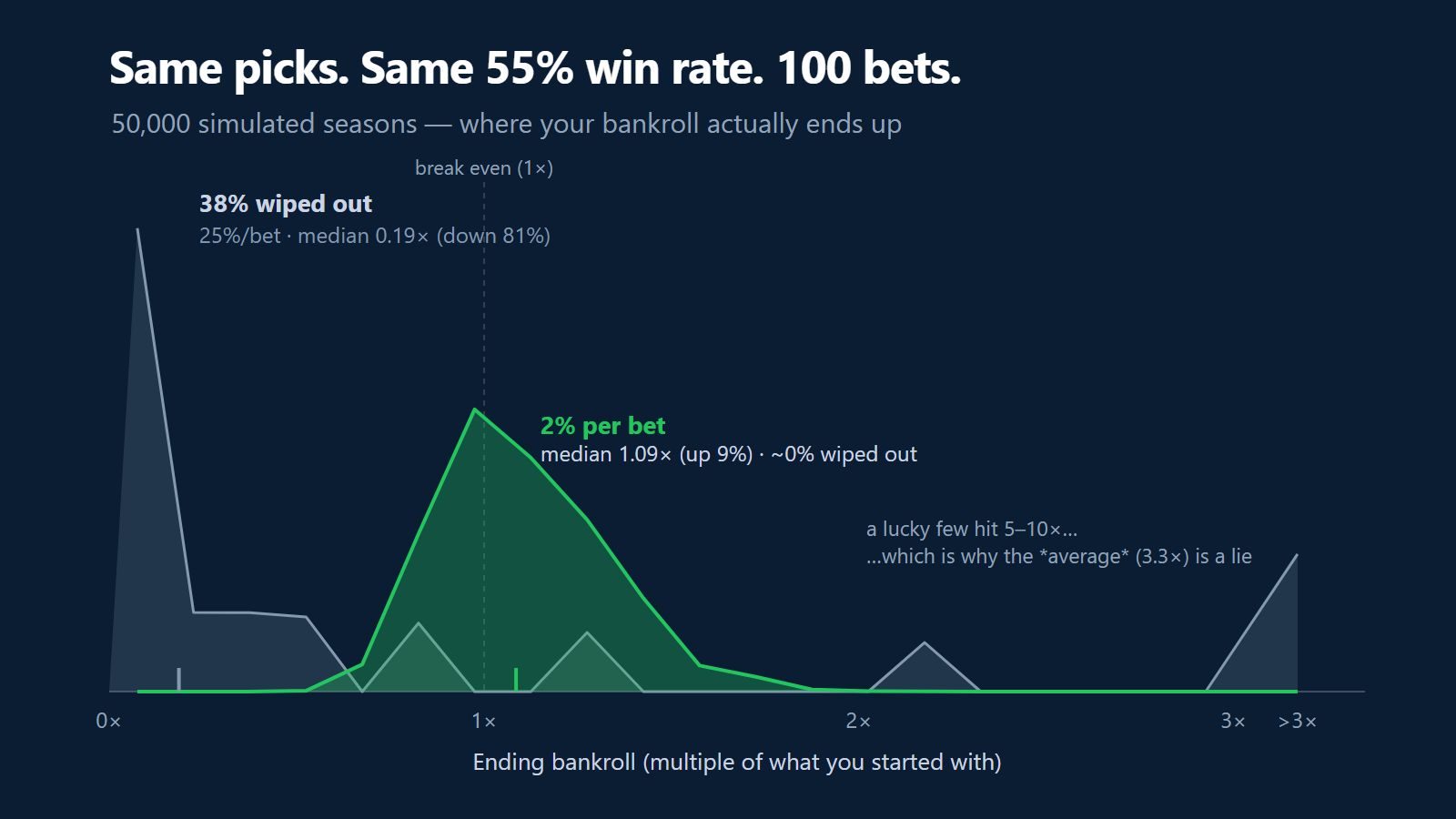
Bettor B's average ending bankroll looks incredible: 3.3×. But the average is a mirage. The typical 25% bettor lost 81% of their bankroll, and 38% of them went broke. That gaudy average is propped up by a lucky handful who happened to hit a 5–10× run. Same picks. Same win rate. Sizing alone was the difference between compounding and ruin.
Bettor A? A quiet, boring +9% median, with almost nobody wiped out.
That's the whole point: variance, not your hit rate, is what busts a bankroll. You can be right more often than not and still lose everything if your sizing is reckless. Sizing is risk management.
Where to go from here
You don't need a spreadsheet full of formulas to fix this. The two moves that matter:
- Put a number on your confidence for each bet, honestly.
- Size proportional to that edge, and scale it down (half or quarter Kelly) because you're not perfect.
That's exactly the problem KellyIQ models. You enter your slate and your read on each game, and it produces the allocation across your whole bankroll under your stated assumptions: Kelly, fractional Kelly, and risk-adjusted views side by side, plus a Monte Carlo picture of where your bankroll could land. It doesn't pick winners and it doesn't tell you what to bet. It does the sizing math the pros do, so the boring, profitable half of betting stops being guesswork.
See how it works, or read the case for treating your slate like a portfolio in what KellyIQ is for.
Frequently asked questions
KellyIQ is a modeling tool. It produces allocation outputs under user-defined assumptions and does not recommend, advise, or predict any wagering outcome. For entertainment; 21+, US only. If gambling is a problem, call 1-800-GAMBLER.
Get new posts by email
Occasional writeups on sizing, risk, and portfolio construction. No picks, no hype.
By submitting, you agree to our Privacy Policy. Unsubscribe at any time.