The Kelly Criterion Formula, Explained in Plain English
The Kelly Criterion is four symbols and one honest number. Here's what each term means, how to run it on American odds, and why two bets that feel identical can be sized twelve times apart.
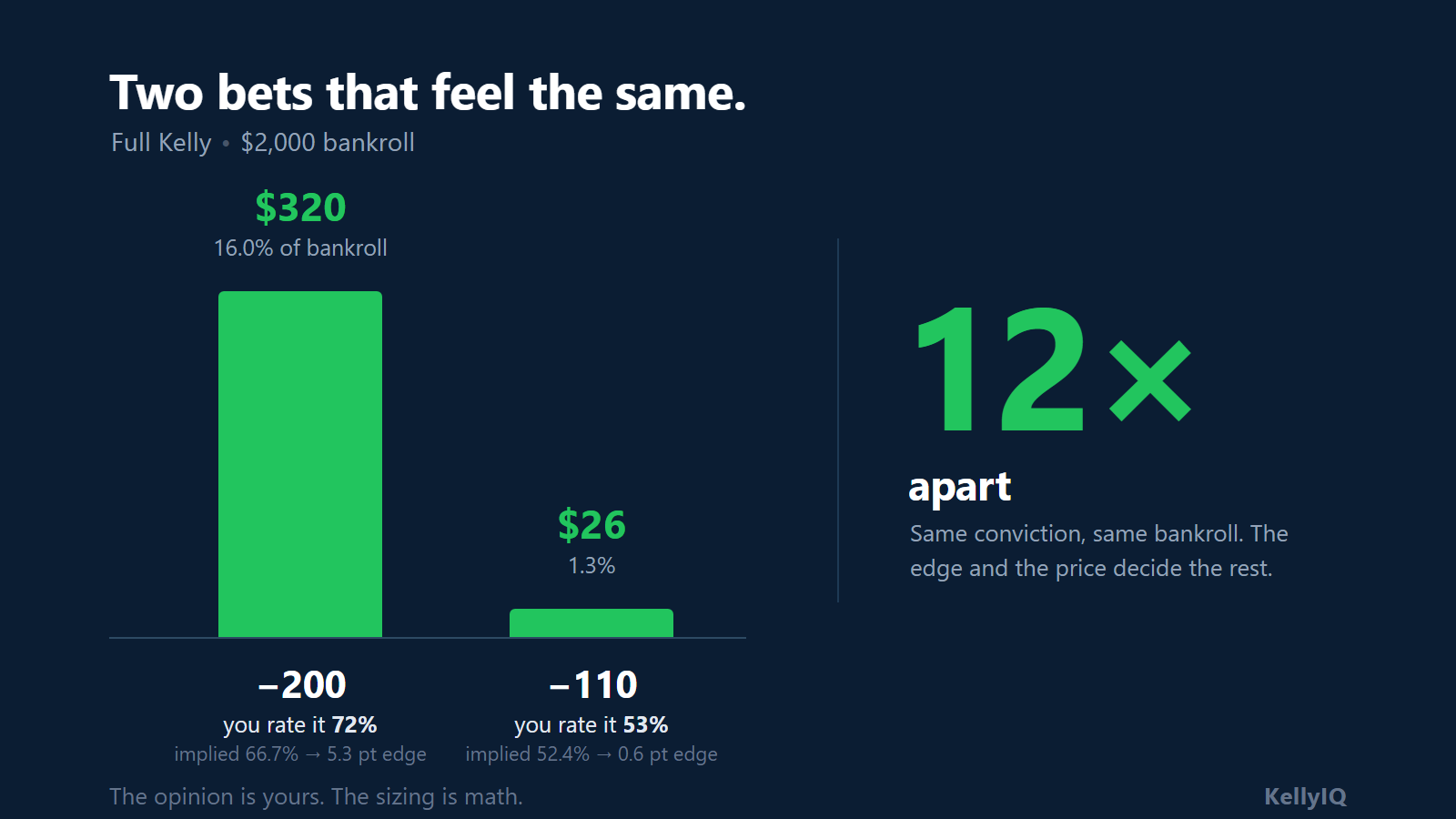
A -200 favorite you rate at 72% and a -110 game you rate at 53% feel like the same kind of bet. Both are "I like this side."
Kelly sizes the first at roughly 16% of your bankroll. The second at 1.3%. More than twelve times apart, on two bets that felt identical when you wrote them down.
Most articles about the Kelly Criterion formula stop once they've shown you the formula. That's the easy part: four symbols and one honest number you supply yourself.
The surprising part isn't the arithmetic. It's that two bets which feel equally strong can deserve completely different stakes.
The Kelly Criterion formula
f = (b × p − q) / b
That's it. Four terms:
fis the fraction of your bankroll to risk on this bet. The output.bis the net odds: what you win per $1 risked. A +150 bet hasb = 1.5. A -200 bet hasb = 0.5.pis your estimated probability the bet wins. The one number that has to come from you.qis the probability it loses, which is just1 − p.
There's a second form that's easier to run in your head:
f = (p × d − 1) / (d − 1)
Both give the same answer. The second one is friendlier because it works directly with
decimal odds, and because the numerator, p × d − 1, is your edge: what you expect to
end up with per $1, minus the $1 you put in. If that's zero or negative, the formula
returns zero or less, which is its way of saying there's no bet here.
Reading it in English
Strip the notation and the formula says one thing:
Bet your edge, divided by your odds.
The numerator is how much you think you're getting paid over fair. The denominator is how much you have to put at risk to collect it. Dividing the first by the second means a big edge on a short-priced favorite and a small edge on a longshot can produce very different bet sizes, because the risk you carry to collect them isn't the same.
That division is also why Kelly never tells you to bet everything on a sure thing you
aren't sure about. As p falls toward the break-even probability, the numerator
collapses toward zero much faster than most people's confidence does.
Getting p and d from American odds
Two conversions, both quick.
American odds to decimal (d):
- Negative odds:
d = 1 + 100 / |odds|. So -110 → 1.909, and -200 → 1.50. - Positive odds:
d = 1 + odds / 100. So +150 → 2.50.
American odds to implied probability, the break-even number, which is what the price says the bet is worth:
- Negative odds:
|odds| / (|odds| + 100). So -110 → 110 / 210 = 52.4%. - Positive odds:
100 / (odds + 100). So +150 → 100 / 250 = 40.0%.
Implied probability is the bar. If your honest estimate of p isn't above it, the Kelly
fraction is zero or negative and there's nothing to size.
One thing worth knowing about that bar: it's inflated. At -110 on both sides, the two implied probabilities add to 104.8%, not 100%. That extra 4.8% is the book's cut, and it's the reason a 52% read on a -110 game isn't a bet at all. It's 0.4 points below break-even.
A worked slate
Say you have a $2,000 bankroll and three games you've put honest numbers on. Games B and C are the two from the top of this page.
| Bet | Odds | Implied | Your p | Kelly f | Full Kelly stake |
|---|---|---|---|---|---|
| Game A | +150 | 40.0% | 45% | 8.3% | $167 |
| Game B | -200 | 66.7% | 72% | 16.0% | $320 |
| Game C | -110 | 52.4% | 53% | 1.3% | $26 |
Working Game A: d = 2.50, so f = (0.45 × 2.50 − 1) / 1.50 = 0.125 / 1.50 = 8.3%.
Game B: d = 1.50, so f = (0.72 × 1.50 − 1) / 0.50 = 0.08 / 0.50 = 16.0%.
Game C: d = 1.909, so f = (0.53 × 1.909 − 1) / 0.909 = 0.0118 / 0.909 = 1.3%.
Now look at what flat betting $100 a game does to that. It puts nearly 4× too much on Game C and about a third of what Game B carries. Same three reads, same night, and the sizing is backwards on two of them.
Games B and C are worth seeing side by side, because they're the two that opened this page:
Why the big favorite got the big bet
Game B is the counterintuitive one. It's the shortest price on the board and it draws the largest allocation, more than the +150 underdog, which pays 5× better.
That's not a quirk. Your edge on Game B is 5.3 points over the implied 66.7%, and you only have to risk $2 to win $1 to collect it. Game A's edge is 5.0 points over a much longer price, so you're risking $1 to win $1.50 on a bet that loses 55% of the time. Kelly is dividing edge by the risk carried to collect it, and short prices carry less.
The general shape: longshots get sized down hard, favorites get sized up, and marginal edges at standard juice get sized down to almost nothing no matter how much you like them.
Fractional Kelly, and why almost nobody runs full
Every number above assumes your p is exactly right. It isn't. Nobody's is.
That matters more than it sounds, because the cost of being wrong isn't symmetric. Overestimate your edge and full Kelly overbets, compounding the error on every wager. The standard response is to run a fraction of the formula's output: half or quarter Kelly.
The trade is better than it looks. In the standard continuous approximation (the same model both sets of figures below come out of) half Kelly keeps about 75% of the long-run growth rate while halving volatility. Quarter Kelly keeps roughly 44% of it.
The drawdown difference is where it gets stark. In that same model, the chance your bankroll touches half its starting value at some point is about 50% under full Kelly, not in a given season, but ever, across a long enough run of bets. At half Kelly that falls to around 12%, and at quarter Kelly to under 1%.
Giving up a quarter of your growth rate to take a 50% drawdown from a coin flip down to one in eight is why fractional Kelly is the default among people doing this seriously. On the slate above, half Kelly turns $167 / $320 / $26 into $83 / $160 / $13.
What the formula doesn't do
Four honest limitations, because the Kelly Criterion formula is narrower than its reputation:
- It can't check your
p. Kelly is a sizing engine, not a handicapper. Feed it optimistic probabilities and it will confidently size an allocation that loses money. Garbage in, precisely-sized garbage out. - It assumes you can bet the exact fraction. Real books have limits, minimums, and moving lines.
- It's a long-run result. "Maximizes growth" means over many, many bets. Any individual season can be ugly and still be correctly sized.
- It sizes one bet at a time. Notice that the three full-Kelly stakes above add to $513, or 25.6% of the bankroll, on a single night. The formula never looked at the other two bets when it sized each one. Applying it three times isn't the same as allocating across three positions competing for the same capital.
That last one is the gap most bettors run into first, and it's the problem KellyIQ models: you enter your slate and your read on each game, and it produces the allocation across the whole bankroll under your stated assumptions, with full and fractional Kelly side by side, per-bet and total exposure caps, and a Monte Carlo picture of where the bankroll could land. It doesn't pick winners and it doesn't tell you what to bet. Our free Kelly Criterion calculator runs the arithmetic on this page for a single bet, with no login and no email.
If you want the case for why sizing matters at all before the formula, start with why flat betting is costing you money. For what the full model does with a slate, see how it works or what KellyIQ is for.
Frequently asked questions
KellyIQ is a modeling tool. It produces allocation outputs under user-defined assumptions and does not recommend, advise, or predict any wagering outcome. For entertainment; 21+, US only. If gambling is a problem, call 1-800-GAMBLER.
Get new posts by email
Occasional writeups on sizing, risk, and portfolio construction. No picks, no hype.
By submitting, you agree to our Privacy Policy. Unsubscribe at any time.