
Should You Cash Out? What That Offer Is Actually Worth
The cash-out button isn't an exit. It's the book buying your ticket back at a price it sets. Here's how to read the line hidden in every offer, and the narrow case where taking a below-fair price still makes sense.
You're up $30 on a bet that pays $68, and there's a button offering to hand you the $30 right now. Press it and the night is over. Leave it and you might get the full $68, or nothing at all.
That feels like a choice between taking the sure thing and getting greedy. It isn't. The cash-out button is the book offering to buy your ticket back at a price it sets, and turning it down is a bet of its own, one with a line you can read in about five seconds once you know where to look.
Declining is also a bet
Hold a ticket and there are two things you can do with it.
Take the offer, and you have C in cash, guaranteed. Decline, and you're holding a
position that pays R (your full return, stake included) if it wins, and nothing if
it doesn't.
So declining risks C to win R − C. That's a bet. Like any bet, it has a break-even:
break-even probability = C / R
That's the whole trick. Every cash-out offer on your screen is quoting you a price, and
C / R is the probability that price implies. Three worked positions, all hypothetical:
| Position | Return if it wins | Offer | Break-even to decline |
|---|---|---|---|
| $100 at +200, "stake back" offer | $300 | $100 | 33.3% |
| $100 at -146, favorite leading in-play | $168.49 | $130 | 77.2% |
| $50 four-leg parlay at +1200, three legs in | $650 | $410 | 63.1% |
The middle row is the bet from the top of this page: $30 in hand, or 77.2% of the time you end up with $68. Now look at the first row, because it's the one that should bother you. The offer that feels safest of all, get your money back and no harm done, is asking you to abandon a position that only needs to come in one time in three. Whether that's a good trade depends entirely on what you think the real number is. But "I get my stake back" tells you nothing about that, and it's the part the interface puts in front of you.
What the book is actually telling you
Here's where it gets interesting. C / R is a gross number. It's the book's estimate
of your win probability with its margin already subtracted. The book's real estimate sits
above it.
Take the middle row. You backed a team at -146, a price implying 59.35%. The game is going your way and the book offers you $130 on a $100 bet. Thirty dollars up, locked in, and the button is right there.
Now back out the margin. The offer implies 77.2%. If that's fair value less a haircut h,
the book's own estimate is (C / R) / (1 − h):
- at a 5% haircut, the book has you at 81.2%
- at a 7% haircut, 83.0%
- at a 10% haircut, 85.7%
So the book is quoting a price that says 77% while privately holding the game in the low-to-mid 80s, and two things follow from that. The ticket is worth about $140, so roughly a quarter of the profit you're feeling good about stays with the book. And by its own number, declining is the better side: holding needs 77.2% to break even, and the book thinks you're at 83%.
That's not a scandal. It's a market maker quoting a two-way price with a spread, exactly like every other price on the site. But it's worth seeing plainly, because nothing on the slip says it.
The spread is charged on what the ticket is worth, not on how far the game has moved. Run it backwards and that's easier to feel: cash out the instant you place the bet, before a pitch is thrown, and you'd be offered about $93. Seven dollars for nothing happening at all. Which is why the next question is how big the position is.
The case where cashing out genuinely wins
If the argument stopped there it would be the usual one: cash out is a rip-off, never press the button. That's wrong, and the reason it's wrong is the most useful part of this whole exercise.
A bankroll compounds. What matters over a long run of bets isn't the average dollar outcome of any single ticket, it's the growth rate of the whole stack, and growth punishes variance. That makes a guaranteed amount genuinely worth more to you than the same expected value with risk attached.
You can put a number on it. There's a cash amount that leaves you exactly indifferent,
where taking it and holding it produce the same long-run growth, and that amount sits
below fair value. (If you want the arithmetic: with a bankroll W outside the ticket,
that indifference point is C* = W × [(1 + R/W)^p − 1], against a fair value of p × R.
It's the certainty equivalent under log growth.)
The gap between those two numbers is a real band. Any offer inside it is below fair value and still raises your long-run growth. Taking it isn't a mistake.
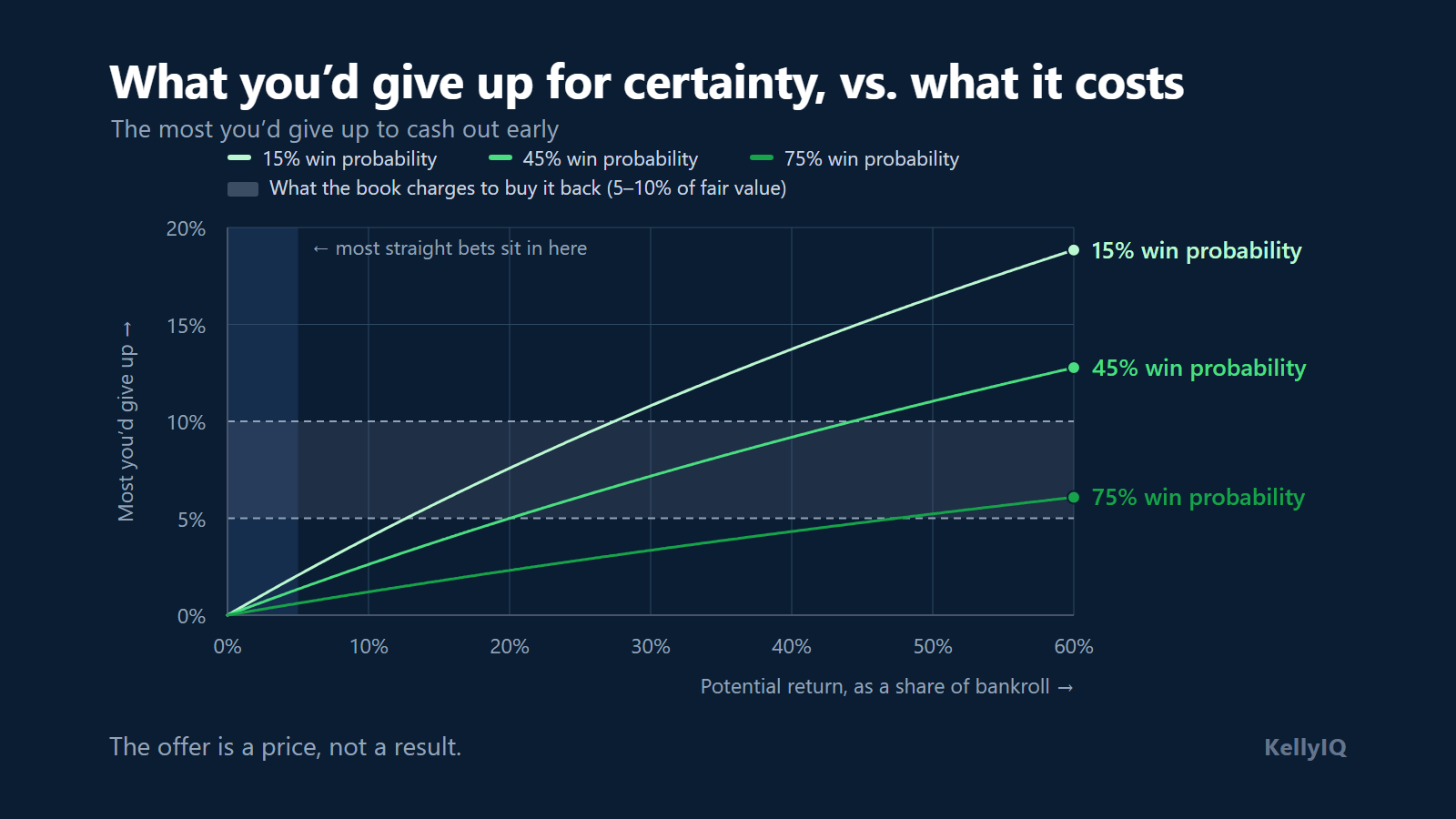
The question is how wide that band is. It depends almost entirely on one ratio, the size of the potential return relative to your bankroll:
| Return as % of bankroll | Most you should give up |
|---|---|
| 1% | 0.2% |
| 5% | 0.9% |
| 10% | 1.7% |
| 25% | 4.0% |
| 50% | 7.4% |
| 100% | 12.7% |
| 200% | 20.2% |
(Computed at a 64% win probability. The band widens as the win probability falls; more on that below.)
Set that against the 5-10% the book is charging and the picture resolves. On a ticket that could return 1% of your bankroll and is currently winning, you should be willing to give up 0.2%, and you're being asked for something like 7%, roughly forty times your tolerance. The button isn't close to worth pressing. On a ticket that could return half your bankroll, your tolerance is 7.4% and the offer is genuinely arguable. The crossover lands somewhere around a return of half your entire bankroll.
Which is why this mostly shows up on parlays
R is your stake times the payout multiple, so the ratio that decides everything scales
with the odds, not the stake.
A $20 bet at -110 returns $38. On a $2,000 bankroll that's under 2%, so tolerance is a third of a percent, nowhere near the haircut. The same $20 on a four-leg parlay at +1200 returns $260, or 13% of the bankroll, and the tolerance goes up more than sixfold.
That's where cash-out lives: parlays, long-shot futures, live positions that have drifted far from where they started. Straight bets on favorites almost never produce a position big enough for the arithmetic to work, which is also why the offers on them look so unappealing once you check them.
A note on slates, since it comes up: if you're holding several tickets that could all move together, the honest version of this question treats them as one position rather than several. That widens the band, but not enough to change anything. Collapse five properly sized tickets into a single perfectly correlated position and the tolerance goes from about 0.2% to about 0.9%. Still nowhere near a 7% haircut. Correlation is a real problem in betting. It just isn't the thing that decides this one.
What if the offer is less than you bet?
Different feeling, same arithmetic. Your original stake appears nowhere in C / R, and it
appears nowhere in C* either. It left your bankroll when you placed the bet. R was
fixed at that moment too, and it doesn't shrink because the game is going badly. The only
thing that has moved is p.
So the same two questions apply, and the numbers just get lopsided. That $100 at -110 returns $190.91 if it comes in. With your team trailing, the offer might be $25, which makes declining a bet that needs only 13.1%. Down badly, an $8 offer needs 4.2%. Those are cheap positions to hold, and the haircut on a small offer costs almost nothing in dollars: 7% of $8 is sixty cents.
One thing genuinely does change. The tolerance band above was computed on a ticket that's winning, and it widens as the win probability falls. At a 10%-of-bankroll position it runs about 1.7% at 64% and about 4.0% at 15%. A long-shot position carries proportionally more variance for the value it holds, so giving up more for certainty is defensible. It's still well short of a 5-10% haircut at any normal position size, but the gap is narrower than it is on a winner.
Which sets up the part worth noticing. Bettors reliably do the opposite of this: they hold losers and sell winners. On a losing ticket that instinct mostly agrees with the math. On a winning one it's precisely where the haircut collects. The offer that feels like free money is the one being sold to you at the widest spread.
What to do with the button
Four practical things fall out of the above.
Read the offer as a price, not as a result. Divide it by your total return and you have the probability it implies. If your own read is meaningfully above that number, the offer is asking you to sell something for less than you think it's worth.
Check a second book before you press anything. If the market is still open you can often lay the other side elsewhere and pay only the vig on that new bet, which is usually a few percent. That's frequently cheaper than a haircut applied to the whole position. Same outcome, different toll.
Partial beats full, when it's offered. Cashing out half locks in some of the position and leaves the rest running, and it charges the haircut on half the money.
And the real fix is upstream. Run the logic backwards: cashing out only starts making sense once a single ticket can swing a serious fraction of your bankroll. If you're staring at the button and the math says press it, that's information about how the bet was sized, not about the button. A position sized so that no single outcome can wreck you is also a position you never feel any urgency to sell back at a discount.
That's the whole point of sizing bets from a stated probability instead of a feeling. Why flat betting costs you money covers the case for it, the Kelly formula, in plain English covers the arithmetic, and the Kelly calculator runs it on a single bet. KellyIQ models the allocation across your whole slate under the assumptions you supply. It doesn't pick games and it doesn't tell you what to bet.
Frequently asked questions
KellyIQ is a modeling tool. It produces allocation outputs under user-defined assumptions and does not recommend, advise, or predict any wagering outcome. For entertainment; 21+, US only. If gambling is a problem, call 1-800-GAMBLER.
Get new posts by email
Occasional writeups on sizing, risk, and portfolio construction. No picks, no hype.
By submitting, you agree to our Privacy Policy. Unsubscribe at any time.