
Half Kelly vs. Full Kelly: The Cost of Being Wrong
Full Kelly maximizes long-run growth on one condition: that your win probability is exactly right. We simulated 50,000 seasons to show what the bankroll does when it isn't, and in this simulation being one percentage point off is enough to flip full Kelly from the best-performing fraction to the worst.
Full Kelly's entire selling point is that nothing grows a bankroll faster over the long run. That is true, and it is worth knowing what it costs.
On a perfectly estimated 55% read at -110, our simulation puts full Kelly's median bankroll about 19% ahead of half Kelly's after 500 bets. To collect that, the full-Kelly bettor sits through a median peak-to-trough drawdown of 66% instead of 39%, and watches the bankroll fall by half at some point in 35% of seasons rather than 7%.
That is a real trade and reasonable people take both sides of it. And it is the good case, the one where the bettor's probability is exactly right. Move the truth by a single percentage point and full Kelly goes from the best fraction on the board to the worst.
What full Kelly promises, and what it assumes
The Kelly Criterion answers one question: given odds and a win probability, what stake maximizes the long-run growth rate of a bankroll. At -110 with a 55% read, the answer is 5.5% of the bankroll.
That answer is exactly right, and it is exactly right about the number you fed it. The formula has to treat your 55% as correct. It has no way to know whether you arrived at it from a model with five years of data or from a feeling about a starting pitcher, and it sizes both identically.
Real probability estimates carry error. That is not a criticism of anyone's process, it is what an estimate is. So the question that matters is not what happens when you are right. It is what happens to the bankroll when you are a little bit wrong.
What we simulated
Every number below comes from the same setup:
- 500 bets at -110, one after another, over what would be roughly a season of regular action.
- A $10,000 starting bankroll, with the stake recalculated as a percentage of the current bankroll before each bet.
- A bettor who believes every bet is a 55% proposition and sizes accordingly, at full, half, or quarter Kelly.
- 50,000 simulated seasons per row, so the percentiles are stable.
Two columns below measure different things and it is worth keeping them apart. Max drawdown is peak to trough within a season, so it is measured from whatever high the bankroll reached, not from the $10,000 start. Seasons ever down 50% counts seasons in which the bankroll fell below half its starting value at any point.
The only thing that changes between the tables is the truth. In the first, the bettor's 55% is correct. After that, the true probability drops while the bettor keeps believing 55% and keeps staking on that belief, which is what an overconfident estimate actually looks like from the inside.
Break-even at -110 is 52.38%, so a 55% read carries an edge of 2.6 percentage points.
The calibrated case: full Kelly wins, and it costs
| Strategy | Median bankroll | 5th percentile | Median max drawdown | Seasons ever down 50% |
|---|---|---|---|---|
| Full Kelly | $19,917 | $2,989 | 65.7% | 35.4% |
| Half Kelly | $16,758 | $6,504 | 38.8% | 6.5% |
| Quarter Kelly | $13,512 | $8,421 | 21.0% | 0.1% |
Full Kelly wins the median by about 19%, and that is the honest version of its claim. It is the growth-maximizing stake and over 500 bets the compounding shows up.
Now look at the rest of the row. The unlucky-but-not-catastrophic full-Kelly season, the 5th percentile, ends at $2,989 against half Kelly's $6,504. The typical full-Kelly season includes a drawdown of nearly two thirds from a previous peak, and more than a third of seasons see the bankroll fall below half its starting value at some point, against roughly one season in fifteen at half Kelly.
That is the trade in the good case: about 19% more median bankroll in exchange for a drawdown profile most people would not sit through. Reasonable bettors take opposite sides of it, and nothing so far says they are wrong. What follows is the part that does.
Now be one point wrong
Here is the same bettor, still betting 5.5% of bankroll on a believed 55%, when the truth is 54%. This bettor still has a real edge: 54% clears the 52.38% break-even by 1.6 points. They are just slightly too optimistic.
| Strategy | Median bankroll | 5th percentile | Median max drawdown | Seasons ever down 50% |
|---|---|---|---|---|
| Full Kelly | $11,761 | $1,765 | 71.1% | 49.5% |
| Half Kelly | $12,884 | $5,001 | 43.1% | 12.9% |
| Quarter Kelly | $11,849 | $7,385 | 23.5% | 0.4% |
One percentage point has taken full Kelly from best to worst. It was 19% ahead of half Kelly a moment ago and it is now behind it, behind quarter Kelly too, and it still carries a 71% median drawdown and a coin-flip chance of the bankroll falling below half its starting value along the way.
Nothing about the bettor's judgment changed. They still hold a real edge: 54% clears the break-even by 1.6 points, and every bet is still a good bet. What changed is that the stake stopped matching the edge.
You estimate 55%. The truth is 54%.
Full Kelly: $11,761, and the bankroll drops below half its starting value in half of all seasons Half Kelly: $12,884, and it does that in one season in eight
Starting bankroll $10,000. Same 500 bets, same -110 price, same one-point error.
The bettor still has a real edge. The bets aren't the problem. The sizing is.
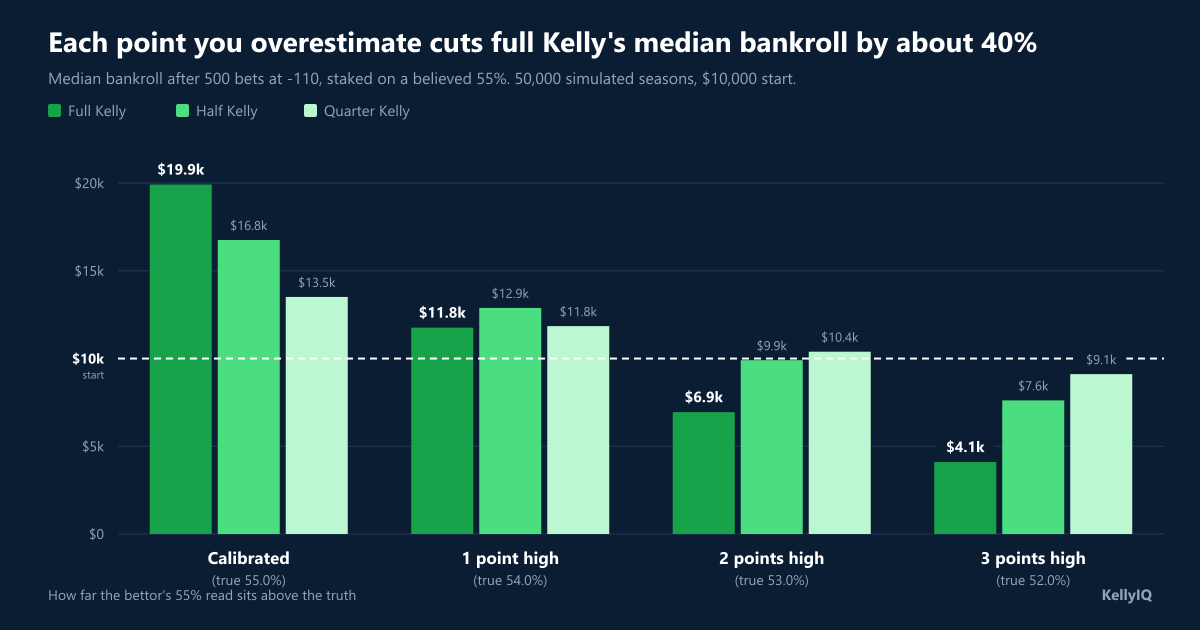
Push the error further and it gets worse in a way that is no longer subtle:
| Truth (bettor still believes 55%) | Full Kelly | Half Kelly | Quarter Kelly |
|---|---|---|---|
| 55.0% (calibrated) | $19,917 | $16,758 | $13,512 |
| 54.0% (1 point high) | $11,761 | $12,884 | $11,849 |
| 53.0% (2 points high) | $6,944 | $9,906 | $10,390 |
| 52.0% (3 points high) | $4,101 | $7,616 | $9,112 |
Read down the columns rather than across the rows. Full Kelly loses roughly 40% of its median bankroll per point of error. Quarter Kelly loses about 12%. At two points wrong, full Kelly's expected logarithmic growth has turned negative and the median season ends below where it started, while quarter Kelly is still, barely, growing.
Half Kelly is not a free pass either. At two points of error its growth is essentially zero and its median lands just under the starting bankroll. The smaller fraction does not make a bad estimate good. It buys room to be wrong.
At two points of error, full Kelly ends below 10% of the starting bankroll in 4.9% of seasons. At three points, that rises to 11.2%. Half and quarter Kelly never once get there in 50,000 seasons at any error level tested.
One line in that table is not like the others, and it is worth separating. At 53% the edge is still real, the bettor still beats the price, and full Kelly has already turned that edge into negative expected bankroll growth. That is the cleanest version of the argument here: oversizing alone destroyed a genuine edge. At 52% we have crossed a different line. Break-even at -110 is 52.38%, so this bettor no longer has an edge at this price at all, and no stake is justified. Fractional Kelly cannot fix that. It can only limit what it costs.
The error tables above assume a bettor whose estimate is too high by the same amount on every bet. A bettor who is right on average is not off the hook either: on a real card you bet the games that clear the price, and those are disproportionately the ones you overrated. Our simulation of estimation error and bet sizing measures that effect. It uses a different setup, so its thresholds do not map onto the tables here.
Why it falls apart this fast
The collapse looks disproportionate to the error, and there is a specific reason for it.
Kelly's growth curve peaks at the Kelly stake and falls away as you move past it. Push the stake far enough beyond the optimum and expected logarithmic growth turns negative.
So the question is not just how many percentage points your estimate missed by. It is how far that error pushes your actual stake past the stake the true edge justifies.
| Truth | True Kelly stake | Your "full Kelly" (5.5%) is | Your half Kelly (2.75%) is |
|---|---|---|---|
| 55.0% | 5.50% | 1.00x | 0.50x |
| 54.0% | 3.40% | 1.62x | 0.81x |
| 53.0% | 1.30% | 4.23x | 2.12x |
| 52.0% | below break-even | no stake is justified | no stake is justified |
A one-point error moves the stake from the peak of the curve to 1.62x. A two-point error puts it at 4.23x, and at that stake the expected logarithmic growth on a true 53% read at -110 is negative. The bettor has not made a modest mistake in sizing. They have turned a real betting edge into negative expected bankroll growth through sizing alone.
Your edge over break-even shrinks much faster than your probability does. Going from 55% to 53% is a 3.6% change in the probability and a 76% change in the correct stake.
Fractional Kelly is a margin of safety against exactly this. At quarter Kelly, a bettor who is 2 points too optimistic is staking 1.06x the true Kelly figure, which is essentially correct by accident.
How to think about picking a fraction
There is no fraction that is right for everybody, because the right fraction depends in part on how much error is in your own probability estimates. What the arithmetic above does give you is the question that actually decides it, which is not "how much risk can I stomach" but how well do I know my own numbers.
Some things that bear on that honestly:
- Where does the number come from? A probability from a model with a meaningful out-of-sample calibration record gives you different evidence than a read on a game you watched. Both are estimates. They are not the same estimate.
- How many bets have you graded? Calibration is measurable. If you have logged your reads and the ones you called 55% have come in at 55%, you know something. If you haven't, you are guessing at your own accuracy on top of guessing at the game.
- Which direction do your errors run? Around a 55% read at -110, the consequences are not symmetric. Being too pessimistic costs you some growth. Being too optimistic pushes the stake toward, and eventually past, the point where growth turns negative: at a true 53% the believed 5.5% is 4.23x the correct figure. That asymmetry is the argument for a smaller fraction, and it does not depend on being risk-averse.
- The drawdown is not hypothetical. A 66% median drawdown means the typical season involves it. Sizing you cannot actually sit through is sizing you will abandon in the middle of, usually at the worst point, which makes the realized result worse than either plan.
Half and quarter are conventions, not results. Nothing in the math makes 0.5 special. They are simply convenient fractions that give up some theoretical growth in exchange for more room to be wrong about the input.
What this doesn't tell you
Four limits worth stating plainly:
- This assumes the edge exists at all. Every table above starts from a bettor who really does beat the price. Fractional Kelly can reduce the damage from betting a nonexistent edge. It does not create one.
- 500 bets is one sample of a long run. These are medians and percentiles across 50,000 seasons. Your season is one draw from that distribution, and one draw tells you very little about whether your sizing was sound.
- It sizes one bet at a time. Every simulation here runs bets sequentially, one position exposed at a time. A real Sunday is six of them at once, competing for the same bankroll, and applying the formula six times independently is not the same as allocating across six positions. That gap is its own subject, and we worked through it in Kelly on one bet is not Kelly on a slate.
- The odds are fixed at -110. Longer prices carry more variance per bet, so the same estimation error does more damage at +400 than the tables above show.
The fastest way to run this article's comparison on your own numbers is our free Kelly Criterion calculator: put in the odds, your probability and your bankroll, and it shows full, half and quarter side by side along with the break-even the price already demands. No login, no email.
That third point, sizing one bet at a time, is where KellyIQ goes beyond a single-bet calculator. It sizes the bets together against the same bankroll and lets you compare full and fractional Kelly under the same assumptions. It does not pick winners and it does not tell you what to bet.
If you want the formula itself first, start with the Kelly Criterion formula explained in plain English. For the case that sizing matters at all, see why flat betting is costing you money.
Not advice. 21+, US only. Bet what you can afford to lose.
Frequently asked questions
KellyIQ is a modeling tool. It produces allocation outputs under user-defined assumptions and does not recommend, advise, or predict any wagering outcome. For entertainment; 21+, US only. If gambling is a problem, call 1-800-GAMBLER.
Get new posts by email
Occasional writeups on sizing, risk, and portfolio construction. No picks, no hype.
By submitting, you agree to our Privacy Policy. Unsubscribe at any time.